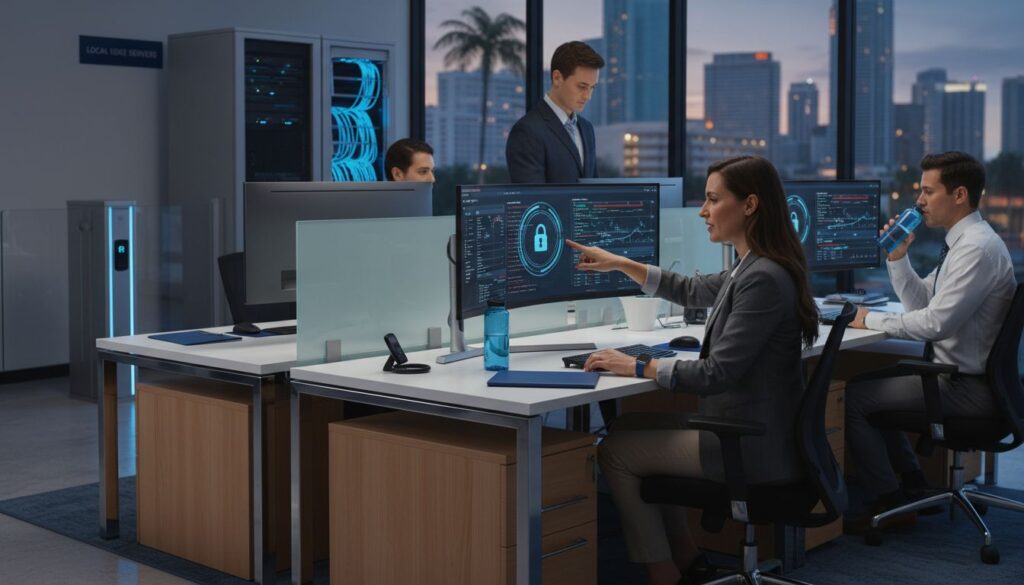
Most accounting firms juggle more data than ever, but only a few know that edge computing can cut data processing delays by over 60 percent. Handling financial records, tax files, and client information often brings slowdowns and rising security risks. As competition among Miami CPAs heats up, finding smarter ways to manage these massive workloads is critical. This guide explains how edge computing transforms accounting operations, making your firm faster, more secure, and ready for the digital future.
Table of Contents
- Defining Edge Computing And Key Concepts
- Types Of Edge Computing Architectures
- How Edge Computing Processes Data Locally
- Top Accounting Use Cases In Miami Firms
- Regulatory Compliance, Risks, And Security
Key Takeaways
| Point | Details |
|---|---|
| Edge Computing Overview | A distributed computing model that processes data closer to its source, reducing latency and enhancing security for accounting data management. |
| Opportunistic Edge Computing (OEC) | Leverages end-user resources for scalable infrastructure, enabling faster financial data processing and real-time reporting. |
| Types of Architectures | Different edge computing architectures (MEC, Fog Computing) allow for localized data handling, improving efficiency and responsiveness in financial operations. |
| Regulatory Compliance | Implementation requires a proactive approach to data security, including encryption and strict access management, to navigate complex regulatory landscapes in finance. |
Defining Edge Computing and Key Concepts
Imagine you’re a CPA drowning in data processing demands. Edge computing is your digital lifeline. According to Wikipedia, it’s a distributed computing model that brings computation and data storage closer to where data actually originates, dramatically reducing latency and bandwidth consumption.
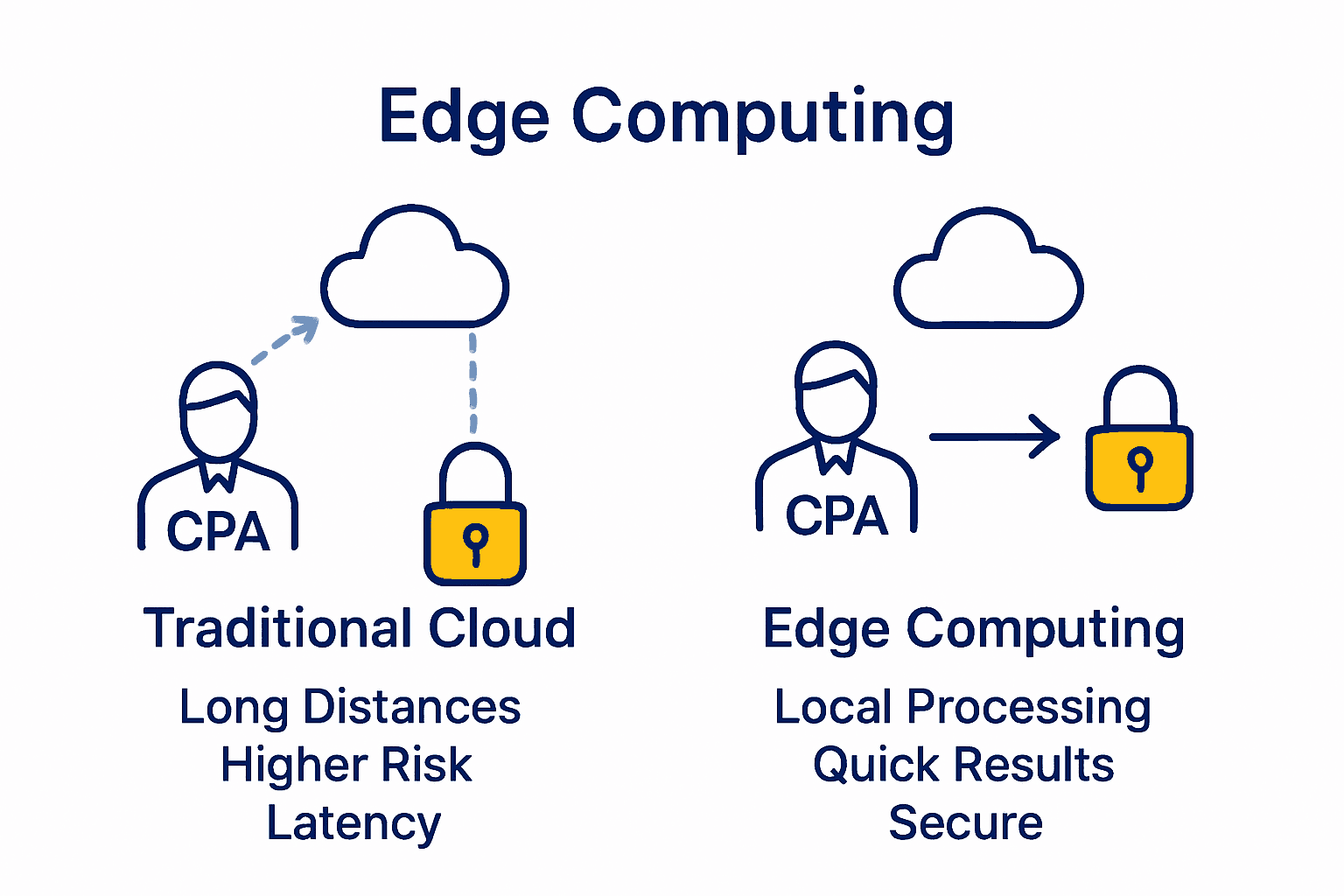
At its core, edge computing solves a massive problem for accounting professionals: processing huge volumes of financial data quickly and efficiently. Think about the massive amounts of transaction records, tax documents, and financial statements your firm handles daily. Traditional cloud computing meant sending all that sensitive data across long network routes, creating potential security risks and slowdowns. Edge computing flips that script by processing data closer to its source.
The real game-changer? Opportunistic Edge Computing (OEC). As research from arXiv reveals, this approach leverages end-user contributed resources to create scalable infrastructures right at the network’s edge. For accountants, this means:
- Faster processing of complex financial calculations
- Reduced network congestion
- Enhanced data privacy and security
- Lower operational technology costs
- Real-time financial reporting capabilities
For accounting firms constantly juggling massive datasets, edge computing isn’t just a tech trend—it’s a strategic advantage. By bringing computational power closer to where data is generated, you’re essentially creating a local financial processing powerhouse that works at lightning speed and with ironclad security.
Types of Edge Computing Architectures
As a CPA dealing with complex data management, understanding the different edge computing architectures is crucial. These aren’t just tech buzzwords—they’re game-changing strategies for processing financial information more efficiently.
Multi-access Edge Computing (MEC) is a powerful approach. According to Wikipedia, this network architecture enables cloud computing capabilities directly at the network’s edge. For accounting firms, this means processing tax records, financial statements, and complex calculations closer to their origin, dramatically reducing transmission delays and network congestion.
Another critical architecture is Fog Computing. As Wikipedia explains, fog computing uses edge devices to perform substantial computation, storage, and communication locally. Imagine your accounting firm’s local servers handling real-time financial data processing without constantly sending sensitive information through distant cloud networks.
These architectures break down into several key types:
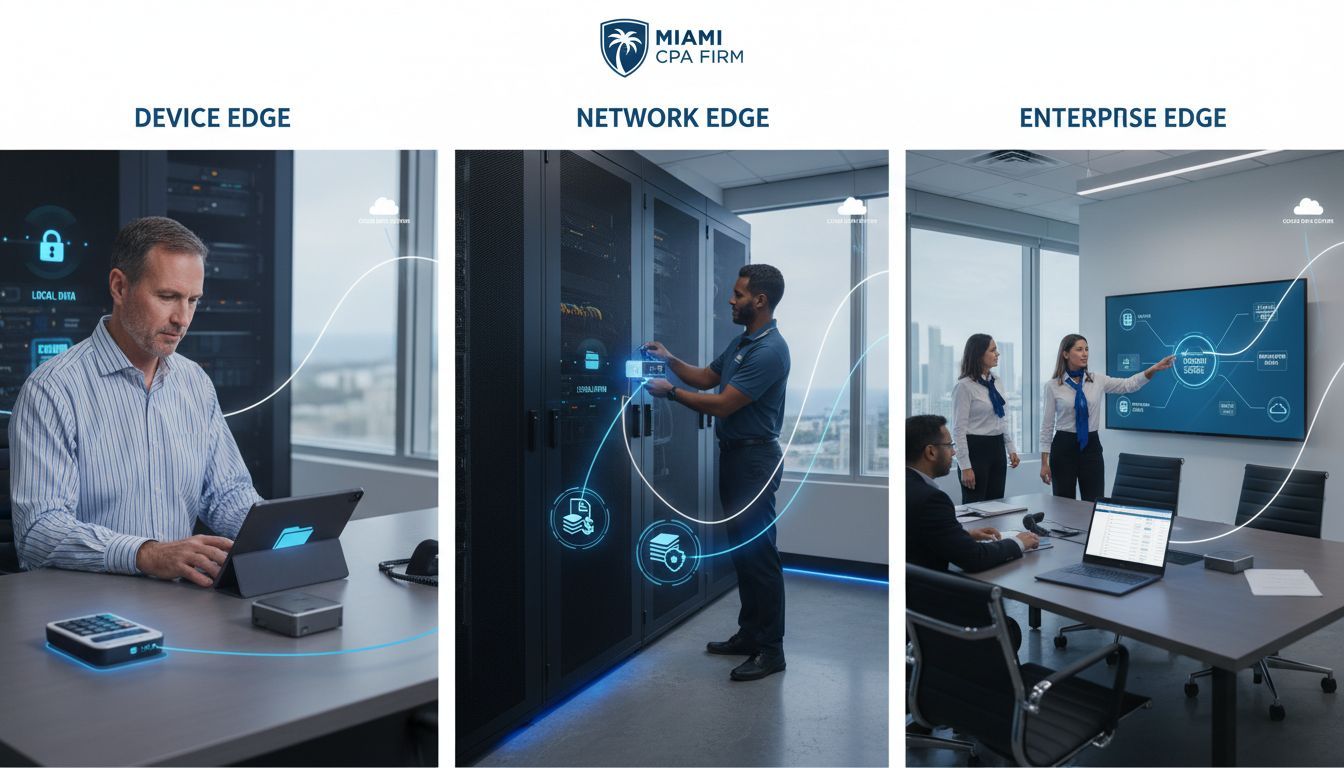
- Device Edge: Processing happens directly on individual devices like laptops, tablets, or local servers
- Network Edge: Computation occurs at cellular base stations or local network infrastructure
- Enterprise Edge: Large organizations create localized data centers within their own facilities
- Cloud Edge: Extension of cloud services closer to the data generation point
For Miami accounting professionals, choosing the right edge computing architecture isn’t just about technology—it’s about creating a secure, efficient, and responsive financial data ecosystem. Each architecture offers unique advantages in speed, security, and operational efficiency, allowing your firm to handle increasingly complex financial data landscapes with unprecedented agility.
How Edge Computing Processes Data Locally
For accountants drowning in data, local processing is a game-changer. According to Wikipedia, edge computing revolutionizes data management by running applications and performing analysis directly on devices near the data source, such as local servers or sensors, eliminating the need to transmit massive financial datasets across complex network routes.
Imagine your accounting firm’s tax preparation workflow. Instead of sending every client’s intricate financial document through multiple network hops, edge computing allows immediate, secure processing right where the data originates. This means lightning-fast calculation of complex tax scenarios, real-time financial reporting, and dramatically reduced network transmission risks.
Research from arXiv highlights how wireless edge computing distributes computing, storage, and control services closer to network endpoints. For CPAs, this translates to some serious advantages:
- Instantaneous financial calculation processing
- Reduced network transmission delays
- Enhanced data security and privacy
- Lower bandwidth consumption
- More responsive client service capabilities
The local processing magic happens through intelligent data filtering and immediate analysis. Instead of sending entire financial records across networks, edge computing allows your systems to process, summarize, and extract only the most critical information. Think of it like having a hyper-efficient junior accountant stationed directly at your data source, rapidly sorting, analyzing, and preparing information before it even reaches your primary systems.
Top Accounting Use Cases in Miami Firms
Miami’s dynamic accounting landscape is being transformed by edge computing, offering unprecedented opportunities for local firms to streamline operations and deliver exceptional client services. From tax preparation specialists in Little Havana to multi-partner downtown firms, edge computing is revolutionizing how financial data gets processed and managed.
The real magic happens in specialized use cases that directly impact Miami’s diverse accounting ecosystem. Imagine real-time tax calculation for import/export businesses near PortMiami, instantaneous financial reporting for hospitality firms in South Beach, or secure data processing for high-net-worth clients in Coral Gables. Edge computing enables accounting professionals to handle complex financial scenarios with lightning speed and unprecedented accuracy.
Here are the top edge computing use cases for Miami accounting firms:
- Real-time Tax Preparation: Instant calculation and verification of complex tax scenarios
- Secure Client Data Management: Localized processing of sensitive financial documents
- Performance Reporting: Rapid generation of financial statements and performance metrics
- Multinational Accounting: Seamless handling of international financial data
- Fraud Detection: Immediate anomaly identification in financial transactions
For Miami firms looking to stay competitive, digital upskilling becomes critical.
 Edge computing isn’t just a technological upgrade—it’s a strategic advantage that allows accounting professionals to process more data, reduce errors, and provide faster, more responsive services to their clients. Whether you’re a boutique firm in Brickell or a multilingual practice serving Latin American clients, edge computing levels the playing field and transforms how financial data gets analyzed and interpreted.
Regulatory Compliance, Risks, and Security
For Miami accounting firms, edge computing introduces a complex landscape of regulatory challenges that demand meticulous attention. According to NIST, specialized frameworks are crucial for ensuring secure and efficient edge computing implementations, particularly in industries handling sensitive financial data.
The regulatory maze becomes particularly intricate when dealing with client financial information. Research from arXiv highlights the critical challenges in managing data privacy, integrity, and access control within distributed computing environments. For CPAs, this means developing robust strategies that protect client information while leveraging the speed and efficiency of edge computing technologies.
Key regulatory and security considerations include:
- Data Sovereignty: Ensuring financial data remains within legal jurisdictional boundaries
- Encryption Protocols: Implementing end-to-end data protection mechanisms
- Access Management: Strict user authentication and permission controls
- Audit Trail Maintenance: Comprehensive logging of all data interactions
- Compliance Monitoring: Continuous verification against financial regulatory standards
As accounting firms navigate the complex world of regulatory compliance, edge computing demands a proactive approach to security. It’s not just about technological implementation—it’s about creating a comprehensive strategy that protects client data, maintains regulatory compliance, and leverages cutting-edge technology to deliver exceptional financial services. Miami accounting firms must treat edge computing security as a mission-critical priority, understanding that a single data breach could compromise years of professional reputation and client trust.
Empower Your Miami Accounting Firm with Edge Computing Confidence
The article highlights how edge computing transforms financial data processing by cutting delays and boosting security for CPA firms. If managing real-time tax preparation, secure client data, and regulatory compliance challenges feels overwhelming, you are not alone. The pressure to handle vast financial information swiftly while safeguarding confidentiality is intense. Edge computing offers clear advantages but implementing and securing this technology demands expert guidance.
Take control today with Transform42 where we align technology and strategy to fit your accounting firm’s unique needs. With guaranteed 99.99 percent uptime and rapid 15-minute response times, we eliminate downtime, security gaps, and compliance risks so you can focus on your clients. Visit our site to learn how Transform42 confidently supports Miami accounting teams in harnessing edge computing benefits without the usual headaches or risk. Don’t wait – secure your firm’s future now by connecting with our experts and turning innovation into peace of mind.
Frequently Asked Questions
What is edge computing?
Edge computing is a distributed computing model that processes data closer to its source, reducing latency and bandwidth consumption. This model is especially beneficial for industries like accounting, where large volumes of financial data need to be processed quickly and securely.
How does edge computing benefit CPAs?
Edge computing offers CPAs advantages such as faster processing of financial calculations, reduced network congestion, enhanced data privacy and security, lower operational costs, and real-time financial reporting capabilities.
What are the different types of edge computing architectures?
The main types of edge computing architectures include Multi-access Edge Computing (MEC), Fog Computing, and several specific configurations like Device Edge, Network Edge, Enterprise Edge, and Cloud Edge. Each architecture provides unique benefits for data processing efficiency and security.
How can edge computing improve data security for accounting firms?
Edge computing enhances data security for accounting firms by allowing local processing of sensitive financial data, which minimizes the risks associated with transmitting large amounts of data over long distances. Additionally, it enables the implementation of robust encryption protocols and access management controls to protect client information.