TL;DR:
- Effective change management significantly boosts project success and organizational performance.
- Tailoring frameworks like ADKAR and Kotter to Miami’s sector-specific needs enhances adoption and results.
- Strong leadership sponsorship, clear communication, and managing change fatigue are key to successful transitions.
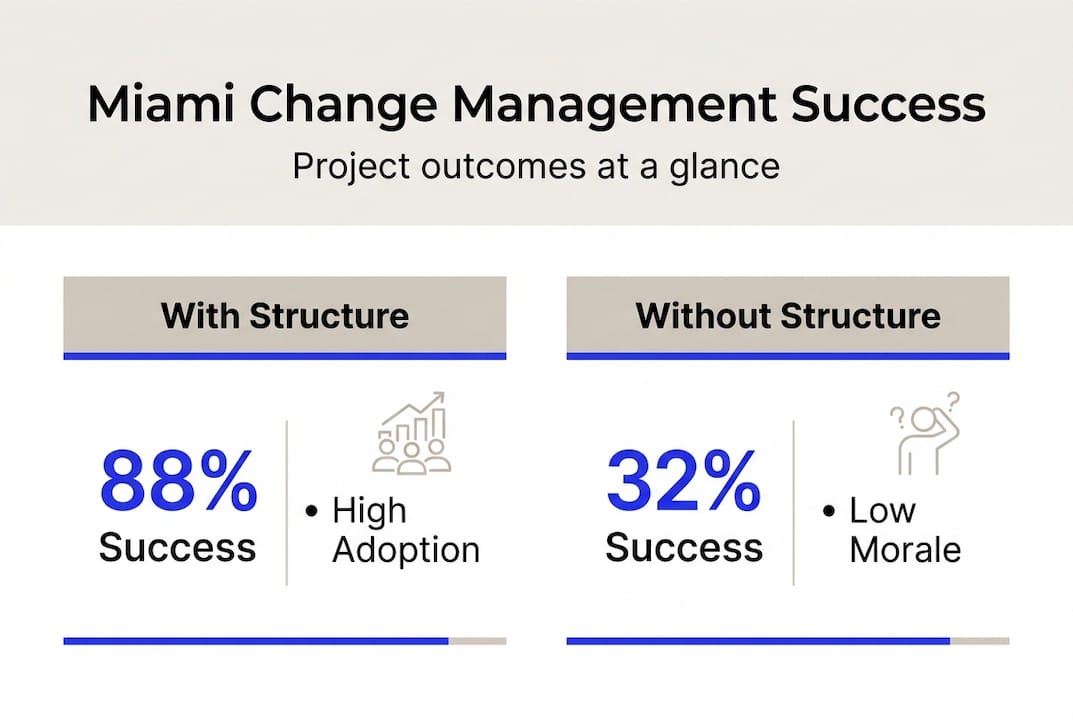
Even the highest-performing accounting, legal, and healthcare firms in Miami can stall when organizational change is handled poorly. Projects with excellent change management succeed at an 88% rate, compared to just 13% with poor management, and organizations with high change effectiveness are 3.5 times more likely to outperform their peers. If your firm is growing, adopting new technology, or restructuring operations, how you manage that transition will determine whether you reach the next revenue tier or lose momentum. This guide walks you through the frameworks, preparation steps, and execution tactics proven to work for Miami’s professional services leaders.
Table of Contents
- Understanding the value of effective change management
- Core methodologies for implementing change management
- Preparation: Setting your organization up for successful change
- Executing and sustaining change: A step-by-step approach
- What most change management guides miss (and how Miami leaders can excel)
- Expert support for your Miami change management journey
- Frequently asked questions
Key Takeaways
| Point | Details |
|---|---|
| Methodology matters | Choosing and adapting a proven framework like ADKAR, Lewin’s, or Kotter’s is critical to driving successful change in professional services. |
| Preparation is foundational | Aligning leadership, clarifying vision, and engaging stakeholders lay the groundwork for effective change management that sticks. |
| Measure and sustain | Track adoption rates and ROI from the start, and use feedback cycles to reinforce gains and make improvements. |
| Local context counts | Miami’s unique client expectations and workforce dynamics require tailored approaches beyond one-size-fits-all models. |
Understanding the value of effective change management
Change management is the structured approach to transitioning individuals, teams, and organizations from a current state to a desired future state. It is not just about rolling out new software or restructuring a department. It covers communication, training, leadership alignment, and the human side of organizational shifts. Understanding the role of change management in your firm’s growth strategy is the first step toward building that capability.
The numbers tell a clear story. Organizations that invest in structured change management see dramatically better outcomes across every metric that matters to professional services leaders: adoption rates, ROI, and client retention.
| Outcome metric | Excellent change management | Poor change management |
|---|---|---|
| Project success rate | 88% | 13% |
| Likelihood to outperform peers | 3.5x higher | Baseline |
| Employee adoption | High | Low |
| Return on investment | Measurable and positive | Often negative |
For Miami accounting, legal, and healthcare firms specifically, the stakes are amplified. Your clients expect uninterrupted service quality. A billing system overhaul at a CPA firm, an EHR migration at a medical practice, or a case management platform switch at a law firm all carry real risk if change is poorly orchestrated.
Here is what poor change management actually costs you:
- Stalled projects that consume budget without delivering results
- Employee resistance that erodes morale and productivity
- Client dissatisfaction from service disruptions during transitions
- Revenue loss from delays in adopting revenue-generating tools
- Talent attrition when staff feel unsupported through uncertainty
One persistent myth is that change fails because of bad strategy. In reality, most failures trace back to people issues, not technical ones. Change management benchmarks from Prosci’s 30 years of research consistently show that the human element is the critical variable. You can have the best ERP system or AI integration platform on the market, but without structured adoption support, it will underperform. Explore change management tips in Miami tailored for accounting firms to see how this plays out locally.
Core methodologies for implementing change management
Choosing the right framework is not about picking the most popular one. It is about matching the model to your firm’s culture, size, and the complexity of the change. The good news is that ADKAR is used by 80% of Fortune 100 companies, making it the most battle-tested model available.
| Framework | Best for | Core focus |
|---|---|---|
| Prosci ADKAR | Tech adoption, role changes | Individual behavior change |
| Lewin’s 3-Stage | Cultural shifts | Unfreeze, change, refreeze |
| Kotter’s 8-Step | Large-scale transformation | Urgency, coalition, vision |
| Prosci 3-Phase | Enterprise programs | Prepare, manage, reinforce |
Here is a quick breakdown of each:
- Prosci ADKAR focuses on five building blocks: Awareness, Desire, Knowledge, Ability, and Reinforcement. It works exceptionally well when you are rolling out new digital change management in accounting tools or automation platforms.
- Lewin’s 3-Stage Model simplifies change into unfreezing current habits, making the change, and refreezing new behaviors. It suits firms making cultural or policy shifts.
- Kotter’s 8-Step Model is built for large-scale, organization-wide transformation. It emphasizes creating urgency and building a strong guiding coalition before executing.
- Prosci’s 3-Phase Process operates at the program level, covering preparation, managing change, and reinforcing adoption. It layers well on top of ADKAR for enterprise initiatives.
For Miami’s professional services sector, a hybrid approach often delivers the best results. A healthcare practice migrating to a new patient management system, for example, might use ADKAR for individual staff adoption while applying Kotter’s coalition-building steps at the leadership level. Review the full Miami CPA change management process to see how this plays out in practice.
Pro Tip: Do not force a single framework onto every initiative. Start with ADKAR for individual-level changes and layer in Kotter’s steps when executive alignment and coalition-building are critical. Blending models is not a weakness; it is strategic.
Preparation: Setting your organization up for successful change
Most change initiatives fail not during execution but during preparation. Active sponsorship from senior leaders is the single biggest predictor of success, followed closely by clear communication, a strong guiding coalition, and proactive management of change fatigue.

Before you launch any initiative, your leadership team must be aligned on three things: the vision for change, the rationale behind it, and the specific role each leader plays in sustaining momentum. Without this, mixed messages will reach your staff and clients, creating confusion and resistance.
Common readiness mistakes Miami firms make:
- Skipping the vision statement: Staff need to understand why before they commit to how
- Overlooking middle management: This layer can make or break adoption
- Underestimating change fatigue: Stacking multiple initiatives simultaneously burns out even your best people
- Ignoring client communication: Especially in healthcare, your patients and clients must understand service continuity plans
For healthcare organizations, success factors for strategic change consistently include maintaining service quality and client satisfaction throughout the transition. Your billing staff, front desk teams, and clinical coordinators all need tailored messaging about what is changing and what is not.
“The most overlooked preparation step is building a guiding coalition. One executive sponsor is not enough. You need champions at every level of the organization who believe in the change and can address resistance in real time.”
Review the role of change management in Miami to better understand how sponsor alignment and coalition-building translate into measurable results for local firms.
Pro Tip: Before launching, run a change readiness assessment with your leadership team. Score your organization on sponsorship strength, communication clarity, and staff capacity to absorb change. If any score is low, address it before you move forward.
Executing and sustaining change: A step-by-step approach
Preparation sets the stage. Execution determines whether your investment delivers returns. Here is a sequential approach that works for professional services firms managing real-world complexity.
- Communicate early and often: Send tailored messages to each stakeholder group. What a partner at a law firm needs to hear is different from what a billing coordinator needs. Personalize the message, not just the medium.
- Deliver targeted training: Generic training modules fail. Build role-specific learning paths tied to the exact tasks changing for each team.
- Run a structured pilot: Test with a small group first. Capture feedback, resolve friction, and refine before full rollout.
- Monitor adoption in real time: Track usage data, completion rates, and support ticket volume. These are your early warning signals.
- Refine and reinforce: Adoption rates and ROI are the ultimate scorecards. Use feedback loops to continuously close gaps.
Change overload is a genuine risk. When firms layer too many initiatives, change fatigue data shows a sharp drop in both adoption and staff morale. Prioritize ruthlessly. Not every improvement needs to happen in the same quarter.
For healthcare practices, the non-negotiable during any transition is client service quality. Patients cannot experience degraded care because your team is learning a new EHR. Build buffer capacity into your timeline and assign dedicated transition support staff during rollout weeks.
- Weekly check-ins with team leads to surface resistance early
- Visible progress dashboards that celebrate milestones and build momentum
- Feedback channels that feel safe and are actually acted upon
- Recognition programs for early adopters who model the new behaviors
Visit our professional services growth strategies page to see how firms like yours are building scalable change capabilities that support revenue growth without proportional headcount increases.
Pro Tip: Assign a dedicated change champion within each department. This person is not a manager; they are a peer who believes in the initiative and helps their colleagues navigate friction in the moment.
What most change management guides miss (and how Miami leaders can excel)
Most guides treat change management as a universal process. Apply the framework, follow the steps, and results will follow. Miami’s professional services landscape is more complicated than that.
Cultural dynamics here are layered. Multilingual teams, multigenerational staff, and a client base with high expectations mean that communication strategies need to be more nuanced than a standard email cascade. A one-size template will not build the trust you need.
What we have seen actually work: leaders who invest in business process change insights specific to their sector, measure early wins visibly, and treat soft factors like trust and morale as seriously as adoption metrics. Change fatigue is not a soft problem. It is a revenue problem. When your team is burned out, client service suffers, and attrition climbs.
The firms that consistently outperform adapt their frameworks to their people, not the other way around. Agility and relentless focus on service quality are not in conflict. They are the combination that wins in this market.
Expert support for your Miami change management journey
Understanding the frameworks is one thing. Having the right technology partner to help you implement them is another.
At Transform42, we support Doctors, Lawyers, and Accountants in Miami who are ready to grow their monthly revenue to an additional 7 to 8 figures. We bring technology solutions for Miami firms that make change manageable and measurable. Whether you need digital transformation experts to guide an ERP rollout or automation tools to scale without proportional hiring, we have the local expertise and proven frameworks to help. Reach out to our Miami IT consulting team to take the next step with a partner who knows your sector.
Frequently asked questions
Which change management model is best for professional services firms in Miami?
ADAKR, Lewin’s, and Kotter’s models all work well, but ADKAR is used by 80% of Fortune 100 companies for its structured phases and adaptability to Miami’s dynamic professional services environment.
How can we measure the success of our change management efforts?
Track adoption rates, project ROI, and stakeholder satisfaction scores. Change effectiveness correlates directly with higher adoption and measurable financial returns.
What are the biggest risks when implementing change in healthcare organizations?
Loss of service quality and employee change fatigue are the top risks. Success factors in healthcare consistently point to communication clarity and maintaining client focus throughout the transition.
How do we overcome resistance to organizational change?
Active sponsorship, transparent communication, and early stakeholder engagement are the proven levers. Active sponsorship and consistent messaging minimize resistance and reduce change fatigue across your teams.