
More than 60 percent of American small accounting firms feel increased pressure to modernize their services, yet many are still searching for a clear path to real digital innovation. For independent CPAs in Miami, embracing transformative technology is no longer optional if you want to keep pace with changing client demands and bigger national competitors. Explore how targeted digital innovation moves your practice from routine tasks to high-value advisory, unlocking new opportunities for revenue growth and competitive advantage.
Table of Contents
- Defining Digital Innovation In Professional Services
- Major Types Of Digital Tools For CPAs
- How Digital Innovation Drives Firm Revenue
- Compliance And Security In Digital Transformation
- Risks And Pitfalls For Small CPA Firms
Key Takeaways
| Point | Details |
|---|---|
| Digital Innovation is Essential | CPAs must embrace digital innovation to improve efficiency and transition to strategic advisory roles, leveraging advanced data analytics and AI technologies. |
| Comprehensive Digital Toolkits are Necessary | Modern accounting practices require cloud platforms, client portals, and automation tools to enhance service delivery and client trust. |
| Revenue Growth through Technology | Implementing intelligent automation and sophisticated analytics can unlock new revenue streams and improve profitability for CPA firms. |
| Addressing Risks is Crucial | Small CPA firms should focus on integrated tech adoption and continuous training to avoid operational inefficiencies and maintain competitiveness. |
Defining Digital Innovation in Professional Services
Professional services like accounting are experiencing a fundamental transformation driven by digital technologies. Digital innovation represents more than just adding new software tools – it’s about fundamentally reimagining how professional work gets accomplished. For CPAs in Miami, this means adopting technology that dramatically enhances efficiency, accuracy, and strategic value delivery.
The digital innovation landscape for professional services involves reimagining business models through technological integration, where traditional processes are reconstructed using advanced digital capabilities. This isn’t simply about automation, but creating intelligent systems that enable professionals to move beyond transactional work into strategic advisory roles. Digital innovation empowers CPAs to leverage data analytics, artificial intelligence, and cloud technologies to provide more comprehensive insights to clients.
Key components of digital innovation in professional services include advanced data processing capabilities, real time collaboration platforms, predictive analytics tools, and integrated workflow management systems. These technologies enable CPAs to transform from number crunchers into strategic financial advisors who can offer predictive financial guidance. By embracing digital innovation, accounting professionals can significantly expand their service offerings and create more value for clients.
Pro Tip – Digital Strategy Assessment: Conduct a comprehensive audit of your current technological infrastructure every six months to identify potential innovation opportunities and eliminate outdated processes that might be holding your practice back.
Major Types of Digital Tools for CPAs
Modern CPAs in Miami require a comprehensive digital toolkit to stay competitive and deliver exceptional value to clients. Essential technologies are revolutionizing how accounting professionals manage data, communicate, and provide strategic insights. The digital landscape for accounting professionals now encompasses multiple interconnected tool categories that transform traditional financial management approaches.

Cloud computing platforms represent a foundational digital tool category, enabling CPAs to access and manage financial data securely from anywhere. These platforms support real-time collaboration, document sharing, and seamless integration across multiple accounting systems. Client portals are another critical digital tool, providing secure communication channels and transparent financial reporting mechanisms that enhance client trust and engagement.
Advanced analytics and artificial intelligence tools are rapidly becoming essential for CPAs seeking to provide predictive financial insights. Machine learning algorithms can now analyze complex financial patterns, identify potential risks, and generate sophisticated financial forecasts. Automation tools streamline repetitive tasks like data entry, reconciliation, and reporting, allowing accounting professionals to focus on higher-value strategic advisory services. Blockchain technologies are also emerging as potential game-changers, offering enhanced security and transparency in financial transactions.
Pro Tip – Technology Integration Strategy: Develop a systematic approach to evaluating and implementing new digital tools, conducting quarterly technology assessments to ensure your accounting practice remains at the cutting edge of digital innovation.
Here’s a comparison of essential digital tools for CPAs and their business impact:
| Tool Category | Key Function | Business Impact |
|---|---|---|
| Cloud Platforms | Real-time secure data access | Enhanced collaboration and flexibility |
| Analytics & AI | Predictive financial insights | Strategic client advisory capabilities |
| Automation | Streamline repetitive tasks | Lower costs and reduced manual errors |
| Blockchain | Secure, transparent transactions | Improved trust and regulatory compliance |
| Client Portals | Secure communication/reporting | Stronger client relationships |
How Digital Innovation Drives Firm Revenue
Digital innovation represents a transformative strategy for CPAs seeking substantial revenue growth in Miami’s competitive accounting landscape. Organizational agility and technological resilience are critical drivers of enhanced profitability that enable accounting firms to differentiate themselves and capture more market value. By strategically integrating advanced digital technologies, CPAs can unlock new revenue streams and dramatically improve their service delivery models.
Data analytics and intelligent automation tools serve as primary revenue acceleration mechanisms for modern accounting practices. These technologies enable CPAs to provide more sophisticated, predictive financial insights that go far beyond traditional compliance services. Machine learning algorithms can analyze complex financial patterns, identify potential optimization opportunities for clients, and generate high-value strategic recommendations. This shift from transactional to advisory services allows firms to command premium pricing and develop more meaningful client relationships.
Revenue generation through digital innovation also involves optimizing internal operational efficiency. By reducing manual processing time, minimizing errors, and streamlining workflow management, CPAs can significantly reduce overhead costs while simultaneously increasing their capacity to take on more clients. The scalability enabled by digital tools means accounting firms can expand their service capabilities without proportionally increasing their human resource investments, creating a direct path to improved profit margins and sustainable growth.
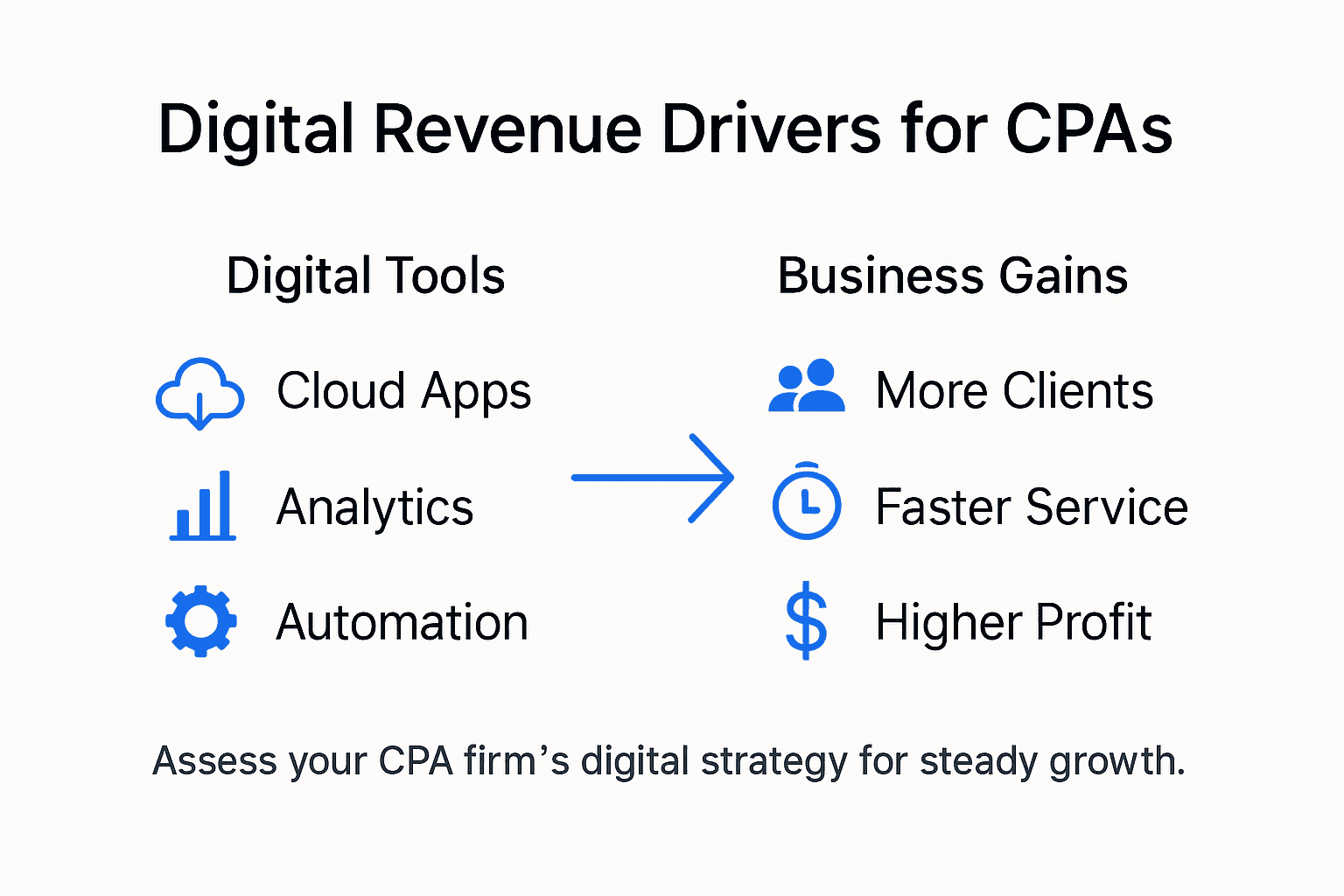
Pro Tip – Revenue Acceleration Strategy: Develop a quarterly digital innovation assessment that maps technological investments directly to potential revenue expansion opportunities, ensuring your firm continuously evolves its service delivery model.
Compliance and Security in Digital Transformation
Digital transformation for CPAs demands a sophisticated approach to compliance and security that goes far beyond traditional risk management strategies. Advanced technologies like artificial intelligence and blockchain are becoming essential tools for enhancing fraud detection and maintaining regulatory standards. Miami accounting firms must proactively integrate robust security architectures that protect sensitive financial data while enabling technological innovation.
Client communication portals and encrypted data management systems represent critical infrastructure for maintaining compliance in the digital age. These platforms allow CPAs to securely exchange sensitive financial documents, implement multi-factor authentication, and create comprehensive audit trails that meet increasingly stringent regulatory requirements. Machine learning algorithms can now continuously monitor transactions for potential anomalies, providing an additional layer of security that traditional manual review processes cannot match.
Compliance in digital transformation also requires a holistic approach that integrates technological solutions with comprehensive staff training and organizational culture. CPAs must develop dynamic risk management frameworks that anticipate emerging cybersecurity threats, understand evolving regulatory landscapes, and implement adaptive security protocols. This means investing not just in technological solutions, but in creating a culture of security awareness that empowers professionals to make informed decisions about data protection and regulatory adherence.
Pro Tip – Security Protocol Development: Create a quarterly cybersecurity risk assessment framework that systematically reviews your firm’s digital infrastructure, identifying potential vulnerabilities and implementing proactive mitigation strategies before they become critical issues.
Risks and Pitfalls for Small CPA Firms
Small CPA firms in Miami face significant challenges when navigating digital transformation, with technological stagnation posing an existential threat to their business model. Neglecting essential technologies can rapidly erode competitive positioning and lead to operational inefficiencies. The risks extend beyond mere technological outdatedness and can directly impact a firm’s ability to attract and retain clients in an increasingly digital marketplace.
One primary pitfall for small accounting practices is underestimating the complexity of digital integration. Many firms mistakenly view technology adoption as an additional expense rather than a strategic investment. This mindset leads to piecemeal technological implementations that create fragmented systems, increased cybersecurity vulnerabilities, and reduced operational efficiency. Inadequate technology infrastructure can result in slower service delivery, compromised data security, and diminished client trust, ultimately constraining the firm’s growth potential.
Technology resistance and skills gaps represent another critical risk for small CPA firms. The rapid evolution of digital tools requires continuous learning and adaptability. Professionals who fail to upgrade their technological competencies risk becoming obsolete in a market that increasingly values data-driven insights and digital expertise. Small firms must develop comprehensive training programs, invest in ongoing professional development, and create a culture of technological curiosity to mitigate these inherent transformation challenges.
This table summarizes common risks for small CPA firms during digital transformation and effective mitigation strategies:
| Risk Factor | Potential Impact | Mitigation Approach |
|---|---|---|
| Fragmented Tech Adoption | Inefficiency, security weaknesses | Invest in integrated platforms |
| Skills Gaps | Loss of competitive edge | Ongoing staff training and upskilling |
| Tech Resistance | Hampered innovation and growth | Foster culture of digital openness |
| Outdated Infrastructure | Data breaches, slow service delivery | Regular technology audits |
Pro Tip – Technology Readiness Assessment: Conduct a comprehensive annual technology audit that evaluates your firm’s digital capabilities, identifies skill gaps, and creates a strategic roadmap for technological integration and staff training.
Unlock Digital Innovation to Drive Revenue Growth for Your CPA Firm in Miami
The article highlights the critical challenge of transforming traditional CPA practices through digital innovation to enhance efficiency, compliance, and strategic client advisory services. If you are struggling with fragmented technology adoption, skills gaps, or outdated infrastructure that limit your ability to scale without proportional hiring and capture bigger clients, you are not alone. The key pain points like digital transformation, compliance, and operational agility from this article align perfectly with the solutions we provide.
Build the capabilities your clients expect with a proven digital transformation strategy tailored for accounting professionals. From integrating predictive analytics and secure client portals to streamlining workflows through automation, we help your firm move beyond transactional tasks into high-value advisory roles. At Stratgetic IT Consultants For Accountants, you will find expert guidance on how to fuse technology and process innovation to safeguard compliance while increasing your competitive advantage.
Stop losing ground to technology resistance or outdated systems. Visit our website today and learn how to reclaim your life by scaling efficiently without sacrificing security or service quality. Ready to lead your Miami CPA firm into a new era of revenue growth? Start with our insights on Processes and Leadership to empower your team and unlock lasting success.
Frequently Asked Questions
What is digital innovation for CPAs?
Digital innovation for CPAs involves reimagining traditional accounting practices through the integration of advanced technologies, enhancing efficiency, accuracy, and strategic value delivery.
How can digital tools help CPAs increase revenue?
Digital tools like data analytics and intelligent automation enable CPAs to offer predictive financial insights, move from transactional work to advisory services, and create new revenue streams by providing higher-value services to clients.
What are the essential digital tools a CPA should use?
Essential digital tools for CPAs include cloud computing platforms for secure data access, analytics and AI for predictive insights, automation tools to streamline tasks, blockchain for transaction security, and client portals for improved communication.
What risks do small CPA firms face during digital transformation?
Small CPA firms may encounter risks such as fragmented technology adoption, skills gaps among staff, resistance to adopting new technologies, and outdated infrastructure, which can hinder growth, efficiency, and client trust.
Recommended
- 8 Essential Digital Strategy Tips for Miami CPAs – Stratgetic IT Consultants for Accountants
- Digital Transformation: Everything You Need to Know – Stratgetic IT Consultants for Accountants
- 8 Essential Digital Strategy Tips for Miami CPAs
- Digital Transformation: Everything You Need to Know
- I Used AI to Multiply My Productivity by 100x | ING Mining