Independent CPAs and financial consultants in Miami often face the challenge of staying ahead in a rapidly evolving industry. As firms turn to internal consultants for specialized strategic support, the demand for professionals who combine deep organizational insight with technological expertise has never been higher. This guide clarifies the critical role these consultants play, revealing how targeted expertise and innovative tools can help your practice achieve significant revenue growth while delivering more efficient client solutions.
Table of Contents
- Internal Consultants Defined For CPAs
- Types And Functions Of Internal Consulting Roles
- Leveraging Technology For Strategic Advantage
- Required Skills And Key Success Factors
- Risks, Limitations, And Best Practices
Key Takeaways
| Point | Details |
|---|---|
| Role of Internal Consultants | Internal consultants within CPA firms focus on strategic advisory roles, utilizing their deep institutional knowledge for operational improvements. |
| Technological Integration | CPA firms are leveraging technology, such as AI and cloud infrastructure, to enhance efficiency and position themselves competitively in the market. |
| Skill Development | Successful internal consultants must possess advanced skills in problem-solving, data analytics, and communication to drive meaningful organizational changes. |
| Risk Management | Internal consultants face ethical and operational risks, requiring strong frameworks for communication and documentation to ensure professional integrity. |
Internal Consultants Defined for CPAs
Internal consultants within CPA firms represent specialized professionals who provide strategic advisory services directly inside accounting organizations. Unlike external consultants, these professionals leverage deep institutional knowledge to drive operational improvements and solve complex financial challenges.
According to the National Association of State Boards of Accountancy, internal consultants are licensed accounting professionals who offer critical services such as:
- Business process optimization
- Regulatory compliance support
- Financial strategy development
- Operational risk management
- Internal audit and control design
These professionals maintain the highest standards of professional conduct while delivering targeted insights that directly impact organizational performance. Internal consultants differ from traditional accountants by focusing on strategic transformation rather than routine compliance activities.
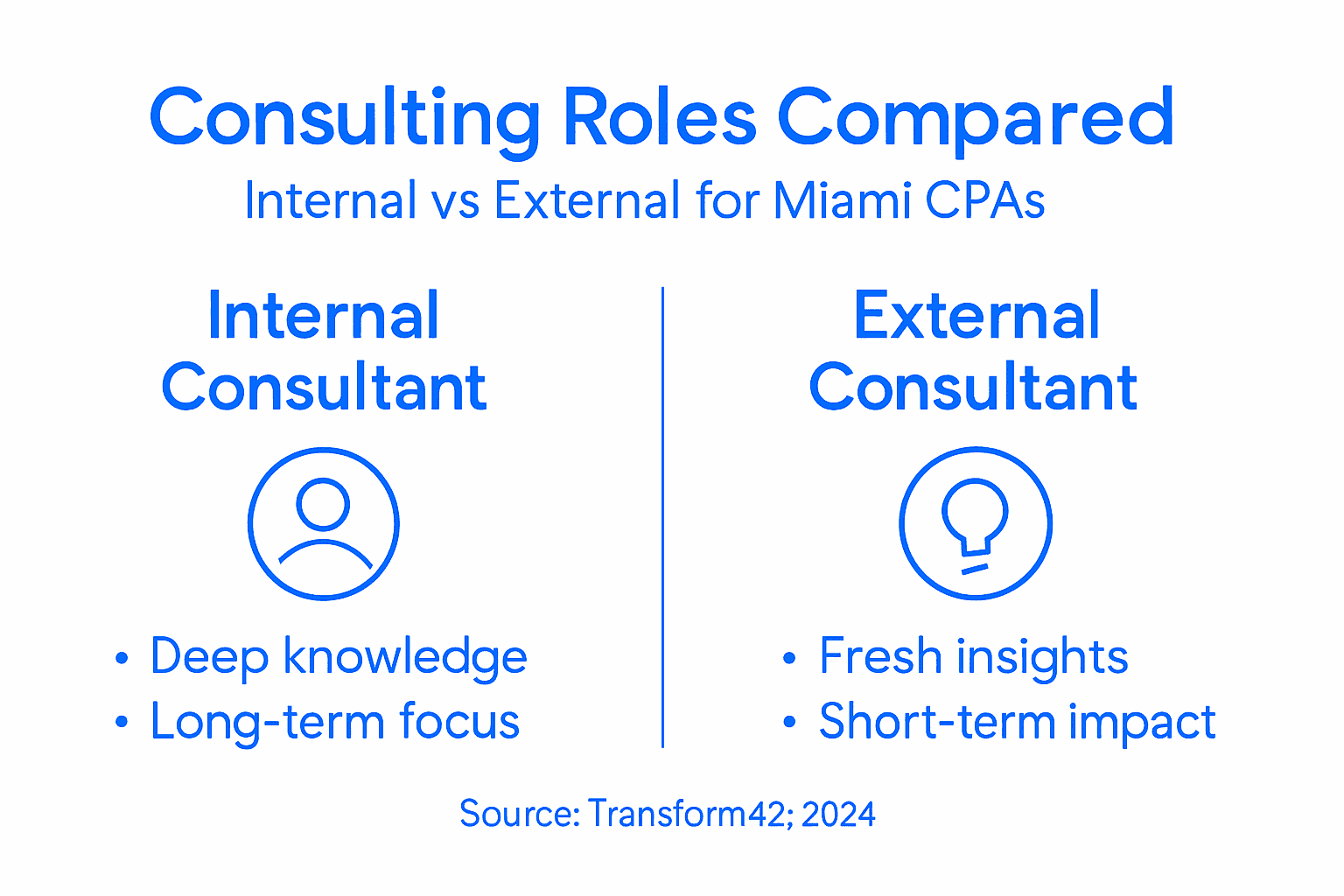
The following table highlights how internal consultants differ from external consultants within CPA firms:
| Aspect | Internal Consultant | External Consultant |
|---|---|---|
| Organizational Role | Employee with long-term involvement | Temporary advisor hired for projects |
| Knowledge Depth | Deep knowledge of firm’s operations | Limited firsthand company knowledge |
| Solution Relevance | Highly tailored, context-driven | Generalized, based on best practices |
| Relationship | Builds ongoing internal partnerships | Works mainly with assigned contacts |
The Office of Professional Responsibility establishes rigorous ethical standards that internal consultants must uphold. This means maintaining absolute integrity, demonstrating technical competence, and ensuring all advisory services meet stringent professional guidelines.
Pro tip: Successful internal consultants build their credibility through continuous learning and developing deep expertise in specific industry verticals.
Types and Functions of Internal Consulting Roles
Internal consulting roles represent a critical strategic function within organizations, providing specialized expertise that drives continuous improvement and organizational transformation. Management experts define these professionals as embedded organizational members who deliver targeted advisory services across multiple operational domains.
These professionals typically specialize in diverse consulting domains, including:
- Technology implementation
- Process optimization
- Strategic planning
- Organizational development
- Risk management
- Performance improvement
- Change management initiatives
According to the Society for Industrial and Organizational Psychology, internal consultants play a multifaceted role in diagnosing organizational challenges, recommending strategic solutions, and facilitating complex transformation efforts. Strategic internal consultants leverage deep institutional knowledge to design targeted interventions that address specific business needs.
Unlike external consultants who provide temporary insights, internal consultants develop long-term relationships within their organizations. They understand nuanced operational dynamics, corporate culture, and strategic objectives, enabling them to craft more contextually relevant and sustainable solutions that align with the organization’s unique challenges and opportunities.

Pro tip: Successful internal consultants cultivate strong relationships across organizational departments while maintaining an objective, analytical perspective.
Leveraging Technology for Strategic Advantage
Modern CPA firms are transforming their service delivery through strategic technology integration, creating unprecedented opportunities for efficiency and client value. CPA firms are utilizing advanced technologies to revolutionize traditional accounting practices and gain competitive market positioning.
Key technological strategies for strategic advantage include:
- Cloud-based infrastructure
- Artificial intelligence analytics
- Automated workflow systems
- Predictive financial modeling
- Real-time compliance monitoring
- Advanced data visualization tools
- Cybersecurity enhancement platforms
According to the Pennsylvania Institute of Certified Public Accountants, strategic technology adoption enables firms to achieve remarkable improvements in audit accuracy, client service personalization, and operational efficiency. These technologies allow CPAs to transition from traditional number-crunching roles to becoming strategic business advisors.
By integrating cutting-edge technologies, CPA firms can develop predictive capabilities that transform raw financial data into actionable strategic insights. This technological evolution enables more proactive decision-making, risk management, and value-added consulting services that differentiate firms in a competitive marketplace.
Below is a summary of key technology trends transforming CPA firms into strategic advisors:
| Technology Trend | Business Impact | Competitive Advantage |
|---|---|---|
| Artificial Intelligence | Enhanced audit accuracy | Automated data analysis |
| Cloud Infrastructure | Greater workflow flexibility | Streamlined remote collaboration |
| Data Visualization Tools | Better client reporting | Clearer strategic insights for clients |
| Cybersecurity Platforms | Reduced information risk | Greater trust and compliance |
Pro tip: Invest in continuous technology training to ensure your team can effectively leverage new digital tools and maintain a competitive technological edge.
Required Skills and Key Success Factors
Successful internal consultants for CPA firms must develop a comprehensive skill set that goes beyond traditional accounting expertise. Professional consulting frameworks emphasize critical competencies that enable transformative organizational impact and strategic advisory roles.
Key skills for internal technology consultants include:
- Strategic problem-solving abilities
- Advanced data analytics capabilities
- Sophisticated communication techniques
- Technology integration expertise
- Risk assessment methodologies
- Stakeholder influence strategies
- Change management proficiency
- Continuous learning mindset
According to the Institute of Internal Auditors, professional skepticism and ethical conduct are foundational requirements for internal consultants. These skills allow professionals to critically evaluate organizational processes, identify potential risks, and recommend meaningful improvements that drive tangible business value.
Technology-driven internal consultants must balance technical knowledge with interpersonal skills. This requires developing a nuanced approach that combines data-driven insights with the ability to communicate complex concepts to non-technical stakeholders, ultimately bridging the gap between technological potential and practical business implementation.
Pro tip: Invest in cross-disciplinary training that combines technical skills with strategic communication to differentiate yourself as a high-value internal consultant.
Risks, Limitations, and Best Practices
Internal consultants in CPA firms must navigate complex professional landscapes fraught with potential ethical and operational challenges. Ethical risks are prevalent in consulting environments, requiring sophisticated approaches to maintain professional integrity and client trust.
Key risks and limitations for internal consultants include:
- Confidentiality management
- Potential conflict of interest scenarios
- Scope creep risks
- Stakeholder relationship complexities
- Potential reputation damage
- Performance expectation misalignments
- Information security vulnerabilities
According to global consulting research, organizational dependency risks can emerge when consulting services replace internal capabilities. Successful firms mitigate these challenges by maintaining a balanced approach that builds internal expertise while strategically leveraging external advisory support.
Professional internal consultants must develop robust frameworks for transparent communication, clear goal setting, and ethical decision-making. This involves establishing precise engagement boundaries, maintaining rigorous confidentiality protocols, and consistently demonstrating value through measurable organizational improvements.
Pro tip: Develop comprehensive documentation and clear engagement contracts that explicitly define consulting scope, deliverables, and ethical expectations to minimize potential risks.
Maximize Tech ROI with Strategic Internal Consulting for Miami CPAs
The article highlights how internal consultants must combine deep institutional knowledge and advanced technology to drive transformational results within CPA firms. Many Miami CPAs face challenges such as improving operational efficiency, managing compliance, and delivering strategic financial insights while avoiding costly hiring spikes. Leveraging technology like AI analytics and cloud infrastructure is essential to gaining competitive advantage and scaling without losing control.
At Transform42, we specialize in empowering Miami accountants to overcome these exact challenges. Our expertise in Digital-transformation Archives – Stratgetic IT Consultants For Accountants ensures your firm integrates cutting-edge tools that enhance audit accuracy, automate workflows, and deliver predictive insights. We help you build the Processes Archives – Stratgetic IT Consultants For Accountants needed for scalable growth while maintaining compliance and operational risk management.
Ready to advance your firm beyond routine compliance and become a strategic advisor your clients depend on?
Partner with us today at Transform42 to unlock your firm’s full technology potential. Build the capabilities that attract bigger clients, streamline your operations, and reclaim the freedom to focus on what matters most. Start transforming your practice now.
Frequently Asked Questions
What is the role of internal consultants in CPA firms?
Internal consultants in CPA firms provide specialized advisory services that drive operational improvements and strategic transformation, leveraging their deep institutional knowledge to solve complex financial challenges.
How do internal consultants differ from external consultants?
Internal consultants are employees embedded within the firm and have a deep understanding of its operations, while external consultants are temporary advisors who may provide generalized insights without substantial institutional knowledge.
What are some key skills required for internal consultants in CPA firms?
Successful internal consultants need a mix of strategic problem-solving abilities, advanced data analytics skills, effective communication techniques, and a strong understanding of technology integration and risk management.
How can CPA firms leverage technology to improve their consulting services?
CPA firms can leverage technologies like cloud-based infrastructure and artificial intelligence to enhance operational efficiency, improve audit accuracy, and provide personalized client service, ultimately transforming them into strategic business advisors.